

Why Scientific Testing Matters
Consumers shopping for insect repellents are surrounded by marketing claims of long-lasting protection, skin safety, or effectiveness against mosquitoes. But scientific testing is what separates proven products from unsupported promises. Scientific testing protects consumers by providing objective evidence that an insect repellent performs as intended.
Through scientific testing, manufacturers can move beyond simple marketing claims and demonstrate measurable performance to consumers. Rather than simply stating that an insect repellent “works”, scientific testing can answer important questions such as: How long does it remain effective? How well does it repel biting insects? Is it gentle on skin? Using consistent and repeatable methods, standardized laboratory testing allows products to be evaluated and demonstrate their performance. Different repellent products can therefore be compared using similar testing methods rather than relying on anecdotal experiences or personal opinions. Likewise, independent scientific testing from accredited laboratories provides greater confidence in product because the results come from organizations separate from the manufacturer.
Choosing products that have undergone independent testing allows buyers to make more informed decisions based on documented performance rather than assumptions. Independent laboratories follow standardized testing methods and evaluate products objectively, helping ensure that performance claims are supported by measurable evidence rather than manufacturer opinion. Scientific testing of insect repellents involve much more than simply determining whether mosquitoes stay away. But what exactly do scientists evaluate before an insect repellent reaches consumers?
What Scientists Test Before an Insect Repellent Reaches Consumers
A single laboratory test cannot answer every question about an insect repellent’s efficacy and safety. To ensure a product is suitable for consumers, laboratories typically test for biting insect prevention and protection time, skin safety, and product reliability.
Protection Effectiveness
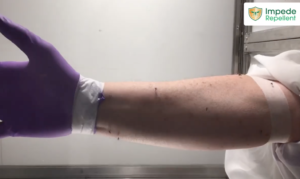
One of the most important questions for evaluating an insect repellent is whether the product actually prevents biting insects from landing and biting. Under standardized conditions, scientists conduct controlled studies to determine how effectively the product repels mosquitoes and other biting insects. Researchers will also determine how long protection continues before the product begins to lose effectiveness. Protection-time studies help establish duration claims that appear on product labels, giving consumers realistic expectations for that product’s performance.
Skin Safety
An effective insect repellent must be comfortable and safe for repeated consumer use according to its label directions. Scientists evaluate whether a product causes skin irritation or allergic reactions after application. These evaluations are especially important for products intended for frequent use, for families with children, or for individuals with sensitive skin. Skin safety testing ensures that consumers can comfortably ad confidently use a product while following its manufacturer’s directions.
Product Reliability
Scientists also assess whether a repellent performs consistently across repeated laboratory evaluations. Reliable, repeatable results help verify that protection claims are based on consistent performance rather than isolated observations. This consistency gives consumers greater confidence that the product will perform as intended when used according to its label directions.
Independent evaluations help build consumer confidence. For IMPEDE, independent laboratory testing has been an important role in verifying both its effectiveness and safety.
IMPEDE Demonstrates Scientifically Testing Protection
Protection Testing
IMPEDE provides up to 14 hours of protection from biting insects, a claim supported by independent scientific testing rather than estimates or assumptions. Studies conducted by Laboratorios Ecolyzer, an independent accredited laboratory in Brazil, and by the London School of Hygiene and Tropical Medicine, both demonstrated protection times of up to 14 hours. Testing by these independent laboratories gives consumers greater confidence that IMPEDE’s protection claims are supported by objective scientific evaluation.
Skin Safety Testing
Effectiveness alone is not enough for an insect repellent to be confidently used for regular and repeated use; skin safety is equally important. The IMPEDE formula has been evaluated for dermal irritation by an independent product testing laboratory in Texas. According to the testing results, there were no reports of adverse reactions, discomfort, irritation, or skin sensitization during the evaluation. Additional certified laboratory testing has also assessed skin sensitivity and toxicity, supporting IMPEDE’s skin-friendly formulation.
Why This Testing Matters to Consumers
Scientific testing allows consumers to choose products with greater confidence, and a product’s claims should be supported by documented evidence. Rather than relying solely on marketing language, buyers should look for products whose safety and effectiveness have been independently evaluated and verified. Independent laboratory testing has verified IMPEDE’s protection time, skin compatibility, and overall product performance. The resulting IMPEDE formula is a repellent that is specifically developed for tropical environments like the Caribbean and designed for families, including children, and individuals with sensitive skin.
When it comes to insect protection, lasting confidence should come from scientific evidence – not simply marketing claims. With independently verified protection, skin safety testing, and long-lasting performance, IMPEDE demonstrates how scientific evidence can help build lasting trust in your insect protection.