
Public Health Is Part of Responsible Business
Businesses play an important role in the health of the communities they serve. From hotels and restaurants, to retail stores and outdoor recreation providers, everyday business practices can influence the health and safety of employees, customers, and the wider community. In the Caribbean, where businesses operate in a tropical environment and tourism is a key part of many economies, protecting public health is an investment in a safer, more resilient business environment.
When businesses take steps to protect public health, the benefits extend far beyond the individual. Through appropriate workplace practices and property maintenance, businesses can help reduce employees’ exposure to preventable health hazards. Likewise, identifying and responding to potential health issues early can also help businesses manage risks before they escalate. Customers are more likely to feel confident in businesses that demonstrate a commitment to health, hygiene, and safety.
Public health encompasses numerous issues, including food safety, sanitation, and infectious diseases. For Caribbean businesses, one environmental concern deserves particular attention: mosquitoes. Common throughout the Caribbean, mosquitoes are among the deadliest animals on Earth because of their ability to transmit harmful diseases to humans, including dengue, Zika, and chikungunya.3 Mosquito-related risks can affect both employees and customers, particularly at businesses with outdoor dining areas, landscaped grounds, gardens, pools, patios, and other outdoor spaces. Because mosquitoes require standing water to breed and lay their eggs, businesses should regularly inspect their properties for potential breeding sites. Any area where water collects can become a breeding site, including planters, discarded containers, tires, gutters, blocked drains, and water-storage containers.1
The good news is that businesses do not have to tackle public health risks, including those posed by mosquitoes, alone. Through consistent maintenance, staff awareness, appropriate mosquito-control measures, guidance from public health authorities, and personal protection, Caribbean businesses can take practical steps to help create healthier environments for everyone who visits or works on their premises.
What Caribbean Businesses Can Do to Protect Public Health
Promoting public health does not require major investments or complicated programs. Many meaningful steps toward preventing mosquito-borne illnesses begin with how a business maintains its property, trains its staff, communicates with customers, and responds to potential health risks. For Caribbean businesses, mosquito prevention involves several practical steps that should be carried out consistently:
-
Inspect and maintain your property
- Conduct routine inspections of the property, including landscaped areas, patios, gardens, parking areas, and outdoor seating. Look for places where water collects or could accumulate.
- Empty or cover containers holding stagnant water and address areas where water collects.
- Check gutters, drains, planters, discarded containers, tires, and other potential mosquito breeding sites .
- Repair leaks and ensure that water-storage containers are properly covered.
- Keep the premises clean and remove waste, debris, and grass cuttings that could obstruct drainage or collect water. Pay particular attention to potential breeding sites after a major storm.
- Arrange regular maintenance of drains and other areas where water may accumulate. 2
-
Train and involve employees
- Explain how mosquitoes breed, where potential breeding sites may be found, and how employees can report problems.
- Assign responsibility for routine inspections to appropriate maintenance, landscaping, and management staff.
- Encourage employees to follow appropriate prevention practices at work and share relevant health information with their families.
- Provide staff with guidance on recognizing symptoms of mosquito-borne illnesses and following established procedures for reporting health concerns to the appropriate health authorities. 1,2
-
Make it easier for customers to stay protected
- Where appropriate, install or maintain screens on doors and windows.
- Consider fans, air-conditioning, and bed nets where suitable for the accommodation or setting.
- Provide clear information about local mosquito risks and practical ways to prevent bites. The Caribbean Public Health Agency (CARPHA) provides informational materials that businesses, including hotels, can display in their lobbies. These materials highlight common mosquito-borne illness symptoms, where to report symptoms, and how to protect against mosquito bites.
- Hotels and resorts may consider making an appropriate insect repellent available to guests, including at check-in.
- Encourage guests to follow product-label directions when using insect repellents, and to take other recommended precautions to prevent bites. 1
-
Establish procedures for health concerns
- Develop a clear process for responding when an employee or customer reports symptoms or appears unwell.
- Know when to direct someone to an appropriate health facility and how to contact local public-health authorities.
- Hotels registered with CARPHA’s Tourism and Health Information System (THiS) can use the system’s reporting procedures to submit relevant symptom and health information through the app.
- Follow applicable public-health guidance and cooperate with authorities when a potential health concern requires further attention. 4
-
Work with the surrounding community
- Coordinate with neighboring properties and businesses to identify shared mosquito-control concerns.
- Participate in community cleanups and local environmental health initiatives.
- Report persistent drainage, waste-management, or mosquito problems to the appropriate authorities.
- When professional mosquito-control services are needed, work with qualified providers and follow local public-health guidance.
- Treat mosquito prevention as an ongoing responsibility rather than a one-time cleanup before a major event or busy season.
How One Caribbean Resort Is Tackling Mosquito Control
Some businesses go beyond routine prevention by investing in targeted mosquito-control strategies. Oil Nut Bay, a luxury resort on Virgin Gorda in the British Virgin Islands, provides an example of how a business can take a proactive, sustained approach to mosquito management.
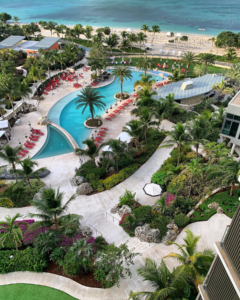
Occupying approximately 400 acres on the eastern end of Virgin Gorda, Oil Nut Bay includes villas, restaurants, beaches, a marina, pools, and other outdoor amenities. Accessible only by boat or helicopter, the resort’s outdoor setting makes the guest experience closely connected to the surrounding environment. Like many Caribbean properties, Oil Nut Bay faced the persistent challenge of mosquitoes. To address the problem, the resort partnered with the BVI environmental nonprofit Green VI and Debug to launch the BugOut program, an insect-control initiative. The program targeted two invasive mosquito species by releasing non-biting male mosquitoes carrying Wolbachia, a bacterium naturally found in many insects. When these males mated with wild females, the resulting eggs did not hatch, helping reduce the targeted mosquito populations over time. The resort reported reductions of 98% in one targeted mosquito population and up to 96% in the other. 3
Oil Nut Bay’s Vice President of Business, Emily Oakes, explained that the goal of the program was to protect human health while preserving local flora and fauna.3 By targeting specific mosquito species rather than broadly affecting the surrounding ecosystem, the approach was designed to help protect guests while preserving the beauty and biodiversity of Virgin Gorda.3 This example demonstrates how mosquito management can be approached as a planned, sustained program rather than relying solely on reactive measures. Not every Caribbean business will need or be able to implement a specialized program of this scale, but the broader lesson applies across the region. Consistent prevention, informed decision-making, and a commitment to protecting people and the environment can make a meaningful difference.
IMPEDE: Supporting Personal Protection for Caribbean Businesses
Business-led mosquito-control efforts can help reduce breeding sites and manage mosquito populations around a property. However, even businesses with strong prevention measures cannot guarantee that every mosquito will be eliminated. Personal bite protection remains another important layer of prevention for employees and customers spending time outdoors.
For businesses looking to support personal bite protection, IMPEDE offers a DEET-free insect repellent designed with Caribbean conditions in mind.
- Designed for Caribbean lifestyles: IMPEDE is intended for people who spend time outdoors in the Caribbean, whether they are working, dining, traveling, or enjoying recreational activities.
- IR3535® active ingredient: IMPEDE uses IR3535®, an established insect-repellent active ingredient, with a long history of safety and mosquito-repellency performance.
- STAYTEC™ technology: The IMPEDE formula uses patented controlled-release technology designed to help reduce evaporation and keep the active ingredient on the skin surface longer.
- Long-lasting protection: IMPEDE provides up to 14 hours of protection against biting insect commonly found throughout the Caribbean.
- Practical formulation: IMPEDE is a lotion-based repellent that is sweat- and water-resistant. Its easy-to-apply formula is also non-greasy and odor-free.
- Made for a range of users: IMPEDE is suitable for use for children as young as 2 months old, pregnant and breast-feeding women, and people with sensitive skin.
Hotels, resorts, tour operators, outdoor recreation providers, and other Caribbean businesses can consider making suitable insect repellent available to staff and guests as part of a broader bite-prevention approach. IMPEDE offers one practical personal-protection option that complements the wider mosquito-prevention strategies businesses can implement.
Caribbean businesses can help promote public health by maintaining clean properties, raising employee awareness, reducing mosquito-breeding sites, and helping customers access appropriate personal protection. From routine maintenance to innovative mosquito-control initiatives, businesses have opportunities to protect the people who work, live, and spend time in their communities. IMPEDE offers an additional option for personal bite protection, helping businesses and individuals enjoy outdoor activities more comfortably while supporting a broader commitment to healthier Caribbean communities.
IMPEDE: Supporting personal protection for a healthier Caribbean.